Overhead Lines or Buried Cables? How to Choose an Electricity Route
Overhead lines or buried cables shape how electricity reaches homes and businesses. Compare route space, disruption and repair access to judge which fits.
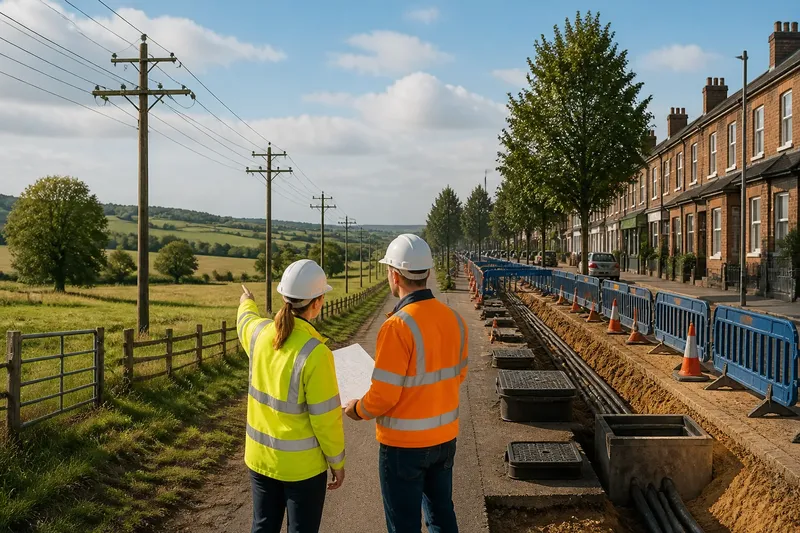
Overhead lines or buried cables put different demands on the route that carries electricity to homes and businesses. The choice is not simply between a visible wire and an invisible one: it affects land use, construction, network access and how crews can restore service after a fault.
What space do overhead lines and buried cables need?
Overhead conductors hang from poles or towers, with clearance needed from buildings, trees and other objects. The supports need a footprint, and the corridor must remain accessible for inspection and maintenance. Land beneath the line may still be used, but the network’s clearances and access needs can limit some activities.
Buried cables sit in trenches or ducts below ground. Their route may also include access chambers and joints, and crews need records that show where the equipment lies. Excavation can affect roads, paths, planting, drainage and existing services such as water pipes or communications ducts.
Neither arrangement removes infrastructure from the landscape. Overhead equipment shares the skyline; underground equipment shares the subsurface with roots, foundations and other utilities. Both choices need space for installation and future network work.
Which option suits an open rural route?
An overhead line can suit open countryside where poles, required clearances and maintenance access can be accommodated. It may avoid digging a continuous trench through fields, which can matter where excavation would interfere with drainage, soil or established land use.
Its supports and conductors remain visible, and their position can affect field boundaries, access and views from homes or public paths. A route that seems clear on a map may still divide a working field or make access awkward.
A buried cable may be preferable where keeping a valued view clear is a priority and the ground can accommodate the works. The route still needs excavation, coordination with existing services and a plan for reaching a fault. In remote locations, access for repair crews can be a particular constraint.
Which option suits a built-up street?
Buried cables can avoid overhead conductors beside buildings and trees, and may suit streets where poles would obstruct the street scene or conflict with clearances. But underground space can already be occupied by sewers, water mains, foundations and communications equipment.
Installation may require road or footpath closures and can disrupt paving, planting and access to nearby premises. A crowded subsurface can make the route difficult to fit, even when an underground line would be less visible after construction.
Overhead lines can be a better fit where a street has room for poles, safe clearances and access for maintenance. Their position is easy to see, but they remain part of the streetscape. The decision should account for both the route above the road and what is already buried below it.
How do crews inspect and repair each route?
Overhead equipment can often be inspected from the ground or with access equipment. Damage may be visible once crews reach the line, though trees, weather, traffic and difficult terrain can complicate the work. Vegetation and nearby structures also need to be kept within the required clearances.
A buried cable does not create a visible obstruction, but its condition cannot usually be judged by looking at the surface. After a fault, crews may need to locate the affected section and excavate. Accurate route records and accessible chambers help, while road layouts and neighbouring services can limit where digging is possible.
Say a local authority is considering an electricity route beside a busy high street. The pavement has little spare space, but a roadside verge appears open. If surveys confirm that the verge can fit poles, clearances and crew access, the authority could compare an overhead route with the disruption of trenching through the street. If residents and planners prioritise an unobstructed skyline and surveys confirm room underground, a buried route could be the better fit; either way, the decision turns on the specific constraints and trade-offs.
What should you check before comparing routes?
- View and landscape: Check which homes, paths and public spaces have sightlines to the route. If poles and wires would dominate a valued view, compare burial; if excavation would damage sensitive ground, compare an overhead corridor instead.
- Existing land use: Check field access, drainage, trees and buildings along the proposed route. If these leave room for poles and maintenance access, assess overhead routing; if supports would obstruct essential use, assess a buried route.
- Underground services: Check service plans and survey results for pipes, ducts, foundations and roots. If the subsurface is crowded, assess an overhead option; if there is a workable corridor below ground, retain burial as an option.
- Street clearances: Check whether poles and conductors can keep the required separation from buildings, trees and road activity. If they cannot, assess burial; if they can, compare the visual and access effects before ruling overhead out.
- Repair access: Check how crews would reach poles, chambers and likely work areas. If a buried route would be hard to excavate without blocking essential access, compare overhead routing; if poles would be difficult to reach, assess whether chambers and a clear excavation plan make burial workable.
- Construction disruption: Check where excavation, reinstatement, pole installation and access works would affect people or land. If trenching would disrupt a busy street or sensitive ground, compare overhead works; if poles would interfere with land use or views, compare burial.
- Who uses the route: Check the needs of residents, landowners, road users and maintenance teams. If one option creates an unacceptable access conflict for a group, assess the alternative route or a design that changes along the corridor.
For a real project, the network operator and relevant road or land authorities can explain which design requirements and local constraints apply. Route selection depends on site surveys and the needs of the electricity network.
What do people ask about overhead lines or buried cables?
Are buried cables invisible?
They are out of sight once the ground is restored, but access covers, warning markers or route restrictions may remain. Installation and later repairs can also affect the surface.
Do overhead lines need space beneath them?
Yes. The route needs suitable clearances, and vegetation or nearby structures may need management. What is allowed beneath a line depends on its design and the site.
Why not bury every electricity line?
Burial avoids visible conductors, but excavation, underground congestion and access for repairs can make it unsuitable on some routes. Less visible does not always mean less disruptive.
Can a route switch between overhead and underground?
Yes. A network can transition between the two where local conditions favour a change. The transition needs space and equipment, so it forms part of the route design.
How do you decide between overhead lines and buried cables?
Compare where each option places its demands: overhead lines need visible corridors, clearances and access to supports; buried cables need underground space, excavation and a practical way to reach faults. Use the checklist to identify which constraints apply before treating either route as the default.
For a mixed landscape, the better choice may change along the route. When comparing overhead lines or buried cables, include how the electricity network will be maintained as well as how it will look on the day construction ends.