From Sunlight to Socket: The Stages Behind Rooftop Solar
Follow rooftop solar from sunlight through panel conversion, inverter and household circuits, so you can understand where the electricity goes.
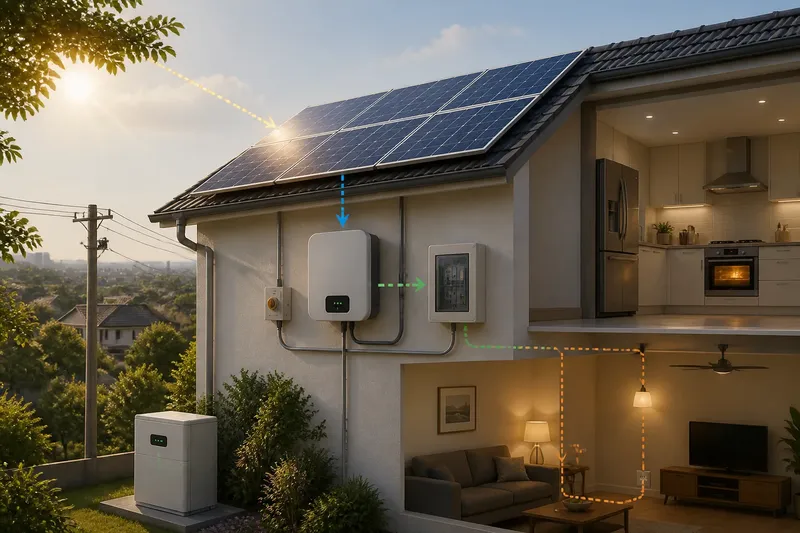
Rooftop solar electricity passes through several distinct stages before an appliance can use it: sunlight reaches the panels, the panels convert light into direct current, an inverter changes that current into alternating current, and the building’s circuits distribute it. Following that path makes it easier to understand what a solar system does—and what it does not do—without confusing energy conversion with wiring or household use.
What happens when sunlight reaches a panel?
A solar panel contains photovoltaic cells, commonly made from semiconductor material. When light reaches these cells, it prompts an electrical response: electrons move, producing direct current (DC). The panel is converting energy from sunlight into electrical energy; it is not storing the electricity for later.
The amount of electrical output changes with the light arriving at the cells. Bright, unobstructed sunlight can support stronger output than deep shade or heavy cloud, though a panel may still produce electricity in diffuse daylight. The panel’s position, surrounding shade, temperature and condition also affect its operation. These influences describe the changing supply, not a promise of a particular amount of electricity.
Panels are joined into a larger array, with electrical connections carrying their combined output towards the equipment that manages it. The array’s DC output is the first electrical stage. It is not yet the form of current used by most household appliances, so another piece of equipment must convert it.
Why does the electricity need an inverter?
Household electrical systems generally use alternating current (AC), while photovoltaic panels produce DC. An inverter performs the conversion between them. It also monitors and manages the solar system’s electrical output, working within the limits and configuration set for that system.
Inverters come in different arrangements. A central or string inverter handles output from a group of panels, while microinverters are fitted at individual panels. Some systems use power optimisers alongside an inverter to manage panel-level output. These options differ in how they handle the array and respond to variations between panels; the labels alone do not tell you which arrangement suits a particular roof.
Once converted, the electricity can be supplied to the building’s electrical system. The inverter does not send power directly to a particular kettle, fridge or light. Instead, it provides an electrical supply that can flow through the building’s circuits to loads that are operating.
How does solar power reach an appliance?
After the inverter, AC electricity joins the building’s electrical system through the appropriate equipment and connection. From there, household circuits carry electricity to sockets, fixed lighting and appliances. A device uses electricity when it is switched on and connected to a suitable circuit.
At the point of use, an appliance converts electrical energy into another form. A lamp produces light and heat; a fan produces movement; a phone charger supplies electricity that the phone can use to charge its battery. Solar panels have not changed their job: they convert sunlight into electricity. The appliance is a separate conversion stage, using that electricity to provide a service.
It helps to distinguish the path from the destination. The panels generate DC, the inverter converts it to AC, and the building’s electrical system distributes it. The appliance then uses electricity when needed. Saying that “the panels power the fridge” is convenient shorthand, but the actual route runs through the inverter and the building’s wiring.
Where does surplus electricity go?
Solar output and household demand do not always match. If the panels are producing more electricity than the building is using at that moment, the surplus may flow towards the electricity network, a battery, or another permitted destination, depending on the system. If household demand exceeds solar output, electricity can come from the network or from storage where a battery is available and configured to supply the building.
This changing balance explains why a roof-mounted array does not automatically mean every appliance is always running on sunlight. A home may use solar electricity directly while the panels are generating, but the source mix can change as clouds pass, appliances switch on or daylight fades. A system without a battery does not keep daytime solar output for use later; a battery, if present, is a separate part of the energy path.
Say you are making lunch on a bright afternoon and the oven, fridge and a few lights are operating. The panels may be supplying some of the building’s current demand, while any shortfall comes from the network or a battery if one is available. If a cloud reduces panel output, the building’s supply can adjust through its connected sources; the observable point is that the appliances remain on while the contribution from each source can change.
What should you check when tracing a solar system?
If you want to understand a particular installation, trace the equipment and connections rather than relying on a single label such as “solar-powered”. A system diagram, inverter display or monitoring app may show useful information, but each presents only the details its equipment is designed to report. For actual operation and safe access, follow the manufacturer’s instructions and ask a qualified professional where the system’s design or local requirements matter.
- Panels: Identify which roof surfaces hold the array and note any regular shade from trees, chimneys or nearby buildings. This helps explain why output can vary across the roof.
- Current type: Check whether a display or diagram distinguishes DC from AC. The distinction shows where conversion takes place.
- Inverter arrangement: Look for a central inverter, microinverters or power optimisers in the system description. This clarifies how panel output is managed before supply reaches the building.
- Building connection: Find the point where the solar system connects to the building’s electrical system on the diagram. Do not open electrical equipment to look for it.
- Battery status: Check whether a battery is included and whether the monitoring information identifies charging or discharging. A battery is not part of every rooftop solar system.
- Network connection: Look for information on export or import if the system provides it. Export indicates electricity moving out towards the network; import indicates electricity coming in.
It is not worth trying to infer the whole system from a phone app’s animated arrows or a single instantaneous reading. Interfaces simplify the electrical path, and a snapshot can change with sunlight and household demand. Use the diagram or equipment documentation to understand which stages exist, then treat live displays as a view of conditions at that moment.
What questions help explain rooftop solar?
Do solar panels produce electricity in cloudy weather?
They can produce electricity under cloud because diffuse daylight still reaches the cells, though output may be lower than in strong direct sunlight. The actual contribution depends on the conditions and the system.
Why do panels produce DC rather than household AC?
The photovoltaic process in the cells produces direct current. An inverter changes it into alternating current so it can supply the building’s electrical system.
Does rooftop solar work when the electricity network goes down?
Many grid-connected solar systems stop supplying the building during an outage unless they include suitable equipment and are configured to provide backup. This behaviour is a safety feature intended to avoid energising parts of the network while it may be under repair; check the system documentation for its specific capability.
Can an inverter make electricity at night?
No. An inverter converts electrical current; it does not generate energy from darkness. At night, a building needs electricity from the network, a battery or another available source.
How can you keep the stages straight?
Keep the rooftop solar sequence in mind: light reaches the cells, the panels produce DC, the inverter converts it to AC, the building distributes it, and appliances use it. That sequence separates generation from conversion and distribution, while leaving room for a battery or network connection to affect where electricity goes.
The most useful question is often not simply whether a home has solar, but which stage you are asking about. For rooftop solar, “What do the panels generate?”, “Where does the inverter send it?” and “Which source is supplying the building now?” describe different parts of the journey. Asking them separately gives you a clearer account of how sunlight becomes electricity at a socket.