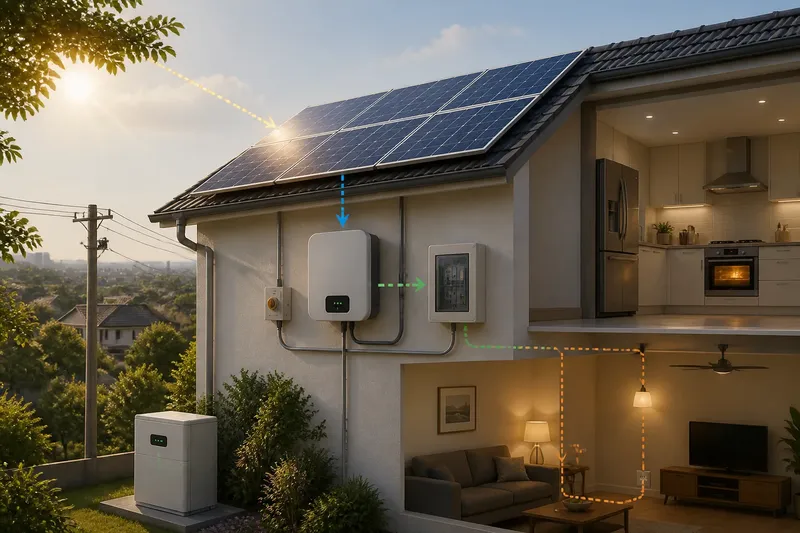
A Battery Is Not a Power Source: What Storage Actually Does
A battery is not a power source in the original sense: see how storage takes in energy, holds it and releases it when a later need arises.

A battery is not a power source in the same sense as a generator: it cannot supply energy that was never put into it. A battery stores energy from an earlier supply and releases it later, shifting when that energy is available rather than creating a new source.
Imagine a community workshop with a small battery system. During one part of the day, its electricity supply exceeds what the workshop is using; later, demand rises while supply is limited. This invented situation makes the battery’s role visible: it takes in energy, holds it in a stored form and returns some of it when the timing changes.
What happens when the workshop charges its battery?
At the start of the scenario, the workshop has access to electricity from an external source. That source might be a connected network, a generator or a renewable generator. The battery is not the origin of that electricity. A charging system directs some of the available energy into the battery, where chemical processes store it.
That distinction matters even when the battery is built into a device and its original supply is out of sight. A charged phone battery, for example, can run the phone away from a socket, but the charging process previously drew energy from somewhere else. The battery changes the timing and location of use; it does not make the energy itself.
In the workshop, the charging control also has to decide when to accept energy and how much to take in. If the workshop needs electricity at that moment, charging may compete with direct use. If supply is available beyond immediate needs, charging can shift some of that energy towards a later period. The decision depends on the equipment, the available supply and the workshop’s priorities.
What does the battery do while it waits?
Once charged, the battery holds stored energy until a device or control system calls for it. “Holding” is not the same as preserving every part of the input indefinitely. Storage systems have operating limits and can lose some energy along the way, including through conversion and the battery’s own internal processes.
For the workshop, the useful question is not simply how much energy went in. It is how much can be delivered when needed, at the required rate, and whether the battery is ready at that point. A store can contain energy but still be unable to serve a particular load if the equipment’s output limits or operating conditions do not suit it.
Storage therefore introduces a gap between supply and use, but it does not make that gap disappear without constraints. The battery needs time to charge, has a finite capacity and must be managed within its operating range. A system designed around one part of the workshop’s routine may not suit a different pattern of use.
How does it release energy later?
Later in the imagined day, the workshop’s immediate demand rises and its incoming supply is less available. The battery’s control system allows stored energy to flow out through the equipment that makes it usable for the workshop’s electrical needs. It is now serving as an immediate source of electricity for the connected loads, but it remains a storage device in the larger energy chain.
That wording avoids a common confusion. From the point of view of a lamp or tool, the battery is the source delivering electricity at that moment. From the point of view of where the energy originated, it is an intermediary: the energy was supplied earlier, stored and then returned. Both descriptions can be true, depending on the question being asked.
In the invented workshop, the observable result is that some equipment can keep running during a period when the original supply is less available. The battery has shifted energy across time. It has not increased the total amount of energy originally supplied, and the amount returned may be less than the amount used to charge it.
What should you check before calling a battery a source?
- Trace the earlier supply. Ask what charged the battery: a network connection, a generator, a renewable source or another storage system.
- Separate charging from discharging. Identify when energy enters the battery and when it leaves for use.
- Check what the battery can serve. Its output capability and the connected equipment determine which loads it can support.
- Look at the timing. Storage is useful when energy is available at a different time from the need it serves.
- Allow for losses and limits. The energy delivered later can be less than the energy used to charge the system, and the battery cannot store unlimited energy.
- Ask what happens when the store is depleted. The battery needs another supply before it can discharge again.
These checks keep the language accurate without making the battery’s contribution sound trivial. A store can make electricity available at a useful moment, support equipment through a change in supply and help a system use energy on a different schedule. Those are meaningful functions, even though they do not turn storage into an original source.
Which questions help explain storage?
Does a battery create electricity?
No: during discharge, it releases energy that was stored earlier, converting it into electricity for connected equipment. The original energy came from the supply used to charge it.
Why can a battery run a device if it is not the original source?
The device needs electricity at the moment it is operating, and the battery can deliver it then. “Source” describes that immediate delivery, while “storage” describes the battery’s role in the wider chain.
Can a battery return all the energy put into it?
Not all of the input is necessarily available for later use. Conversion and internal losses, along with operating limits, mean the energy delivered can be lower than the energy used during charging.
What happens after the battery runs down?
It can no longer supply energy from that stored charge and needs to be charged again. What supplies the next charge depends on the system connected to it.
What does the workshop’s example teach?
The hypothetical workshop’s battery does not replace the need for an energy supply. It gives the workshop a way to use some supplied energy later, when immediate demand and incoming availability no longer line up. To understand a battery’s role, follow the energy through its full path: original supply, charging, storage, discharge and use.
So when someone calls a battery a power source, ask whether they mean the device supplying electricity right now or the origin of the energy. That small distinction makes the battery’s real contribution clearer: storage moves energy through time, while another source must put it there first.