A Calm Energy Check for a Room You Use All Day
A calm energy check helps you map when lights, screens and everyday devices are in use, revealing room routines without meters, repairs or disruption.
A calm energy check makes the everyday energy use in a room easier to see without measuring anything or changing how a device works. Choose a room you use throughout the day, such as a home office or kitchen, and notice which lights, screens and ordinary appliances are active as your routine unfolds.
The aim is not to judge each choice or hunt for a fault. It is to build a simple picture of what is being used, when it is used and what is happening around it. A few observations can reveal patterns that are otherwise easy to overlook, such as a screen left on between tasks or a lamp used only when daylight fades.
What does an energy check actually observe?
This exercise follows visible use rather than electricity itself. You record whether a device is in use, in standby, or apparently off, and connect that state to an activity or moment in the room. You do not need to know how much electricity the device draws to notice that it is on.
Keep the categories plain. “In use” means someone is actively using the device, such as typing on a computer. “Waiting” means it remains powered or ready while nobody is using it, such as a television displaying a standby light. “Off” means it appears switched off. If you cannot tell, write “unclear” rather than guessing.
These labels describe what you can observe, not the device’s internal electrical state. Some equipment can remain connected or draw power even when its display is dark. The check is still useful: it records the visible routine, not a precise account of electricity consumption.
How can you observe without interrupting the room?
Pick a period that reflects an ordinary day. You might observe the room during a workday, a day at home, or the stretch from breakfast to bedtime. Do not create a special routine for the exercise; unusual behaviour would give you a less useful picture of how the room normally works.
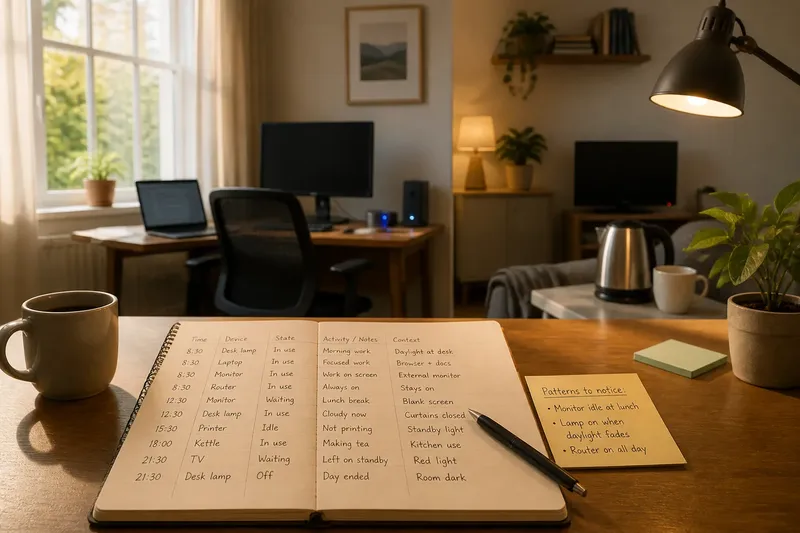
Use a small notebook, a sheet of paper or a notes app. Write down the time or a simple time cue, such as “morning”, “lunch” or “after dark”. Then list the visible devices and what they appear to be doing. A short note is enough: “desk lamp on; laptop in use; printer idle”.
You can make observations at natural pauses rather than watching constantly. For instance, glance around when you enter the room, leave it for another task, or finish a meal. If you miss a period, leave it blank. Do not fill gaps from memory unless you clearly mark the note as an estimate.
Stay with ordinary, low-risk observation. Do not open equipment, unplug anything, move cables, touch hot surfaces or inspect fittings. If a device seems damaged or unsafe, stop the exercise around it and seek appropriate help rather than treating the check as a repair task.
Which details make a routine easier to understand?
A list of devices is a starting point, but the surrounding activity gives it meaning. Note what the room is being used for: focused work, cooking, conversation, reading or passing through. The same light or screen can serve a different purpose at different times, so context helps you interpret what you see.
It can also help to record natural conditions that affect use. Write “daylight at desk” or “curtains closed” if that explains why a lamp is on. Note whether a screen is being used for work, entertainment or a call. Keep these descriptions neutral; the point is to understand the routine rather than grade it.
Distinguish devices that stay in the room from those that appear only briefly. A router may remain on throughout the day, while a kettle is used for a short task. That contrast shows why counting visible devices alone is not a reliable way to compare energy use. A device’s energy demand depends on its design and operation, not simply on how long it is seen in the room.
Say you use a spare room as a home office. In an invented scenario, your notes show the desk lamp on during a bright morning, the laptop active through several work periods, and the monitor left displaying a blank screen during lunch. That pattern does not prove the monitor is wasting energy or establish its consumption; it gives you a clear question to consider later: does the screen need to remain ready during that break?
What should you do with observations that seem unclear?
Ambiguity is normal. A small indicator light may be difficult to see, or a device may be connected to a socket without showing whether it is operating. Record only what is visible. Avoid assigning a power state based on a sound, warmth or assumption unless you can describe that observation plainly.
Some equipment serves several people, and a device that appears idle to you may be needed by someone else. If the room is shared, include “shared use” or ask the other person what a device is for before drawing conclusions. Do not record private information from screens, calls or personal routines; a useful energy note needs only the device and its broad activity.
Labels and manufacturer instructions matter if you later need to understand a particular device or decide whether it can be switched off. Local requirements may also apply to equipment in some settings. For the observation exercise, though, there is no need to investigate those details or handle the equipment.
What questions help make sense of the notes?
Do I need a plug-in energy meter?
No. This check is about visible routines, not readings or comparisons of electrical consumption. A meter would introduce a different task and may not be appropriate for every device.
Should I change a routine while observing?
No. Let the room run as usual so your notes describe the pattern you actually want to understand. If you deliberately alter behaviour, keep that for a separate decision after the observation.
What if I cannot tell whether a device is on?
Mark it “unclear” and move on. A calm check is more useful when it separates what you saw from what you inferred.
How long should I keep the notes?
Stop when you have enough observations to recognise a routine or when the exercise starts to feel burdensome. There is no need to keep a detailed log indefinitely; a brief, readable record is easier to use.
Which patterns are worth noticing?
Look for repetition rather than isolated moments. A lamp may come on each time a particular task begins; a screen may remain active whenever the room is empty; or a device may be used only at a certain part of the day. A recurring pattern offers a more useful prompt than a single observation.
Notice how daylight, occupancy and task changes relate to device use. A light switched on when someone enters a dim corner may be serving a clear need. A screen left on after a meeting may reflect a transition between tasks. The observation does not tell you what choice is right; it helps explain how the current choice fits into the room’s routine.
It is not worth trying to calculate a room’s total energy use from a visual log, or ranking devices by apparent importance. Without technical information about the equipment and its operation, those conclusions would be guesswork. Keep the record at the level it can support: visible use, context and repeated timing.
How can you turn the check into a useful next question?
Read the notes once and choose one pattern that genuinely matters to you. You might ask whether a light is serving a task, whether a shared device needs to stay ready, or whether a screen is simply being left on during a regular break. A good next question is specific enough to consider without assuming that every observed use should change.
If you decide to adjust a habit, make one modest change at a time and pay attention to whether it fits the people and work in the room. You can also decide that a device’s current use is necessary or convenient. The point of an energy check is to make the routine visible, not to force a particular outcome.
A calm energy check works best as a short aid to attention: note what is in use, connect it to the room’s activity, and leave uncertain details uncertain. With that simple record, everyday energy use becomes easier to discuss and the next decision can be based on the routine you actually observed.